Introduction
The CloudFiles: Create SharePoint Site flow action allows users to automate the creation of new SharePoint sites directly from Salesforce. This is particularly useful for organizations that need to quickly spin up collaboration spaces for projects, teams, or departments without manual intervention.
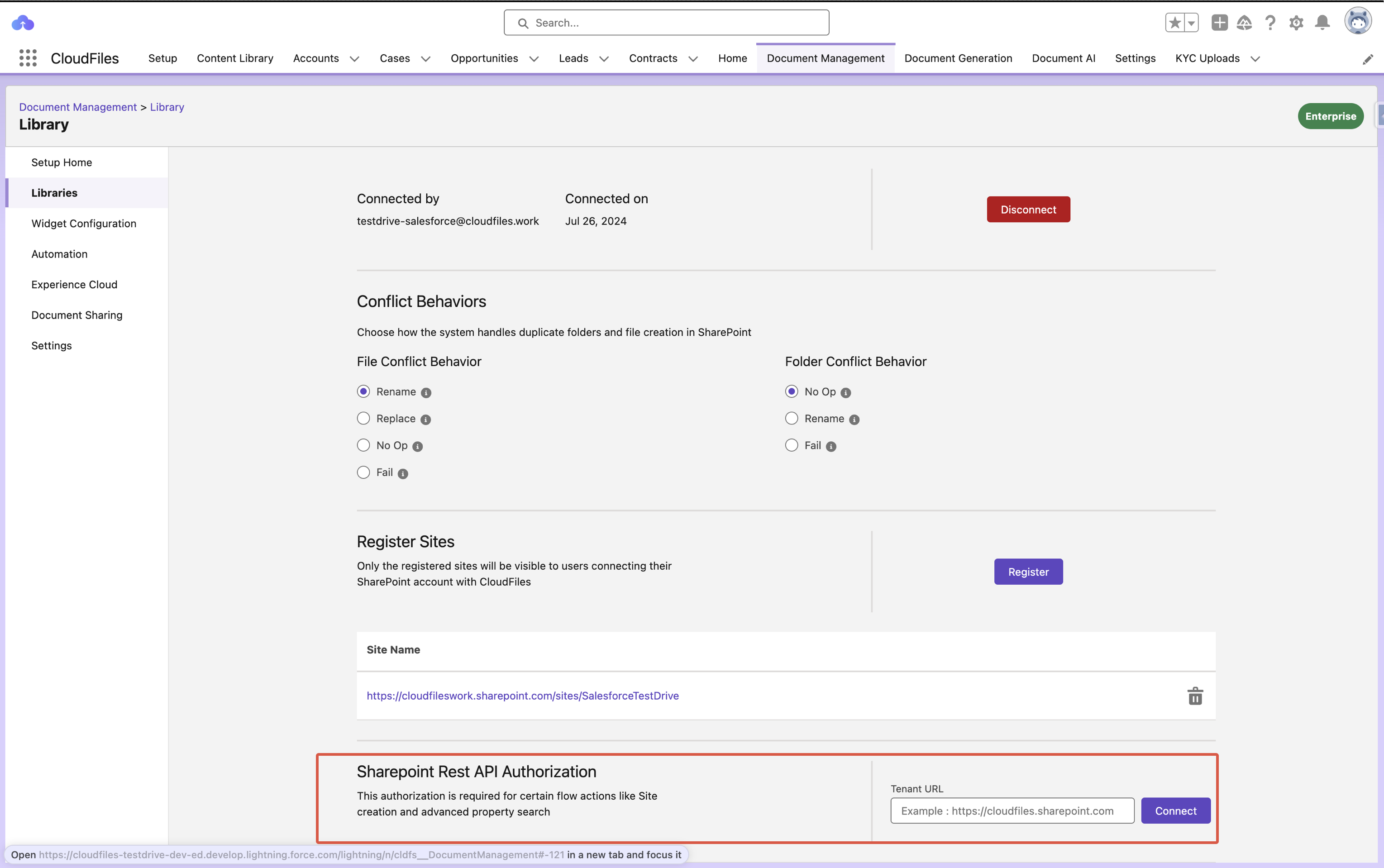
SharePoint Rest API Authorization is required for certain flow actions like Site creation.
Navigate to CloudFiles > Document Management > Libraries > SharePoint to configure the same.
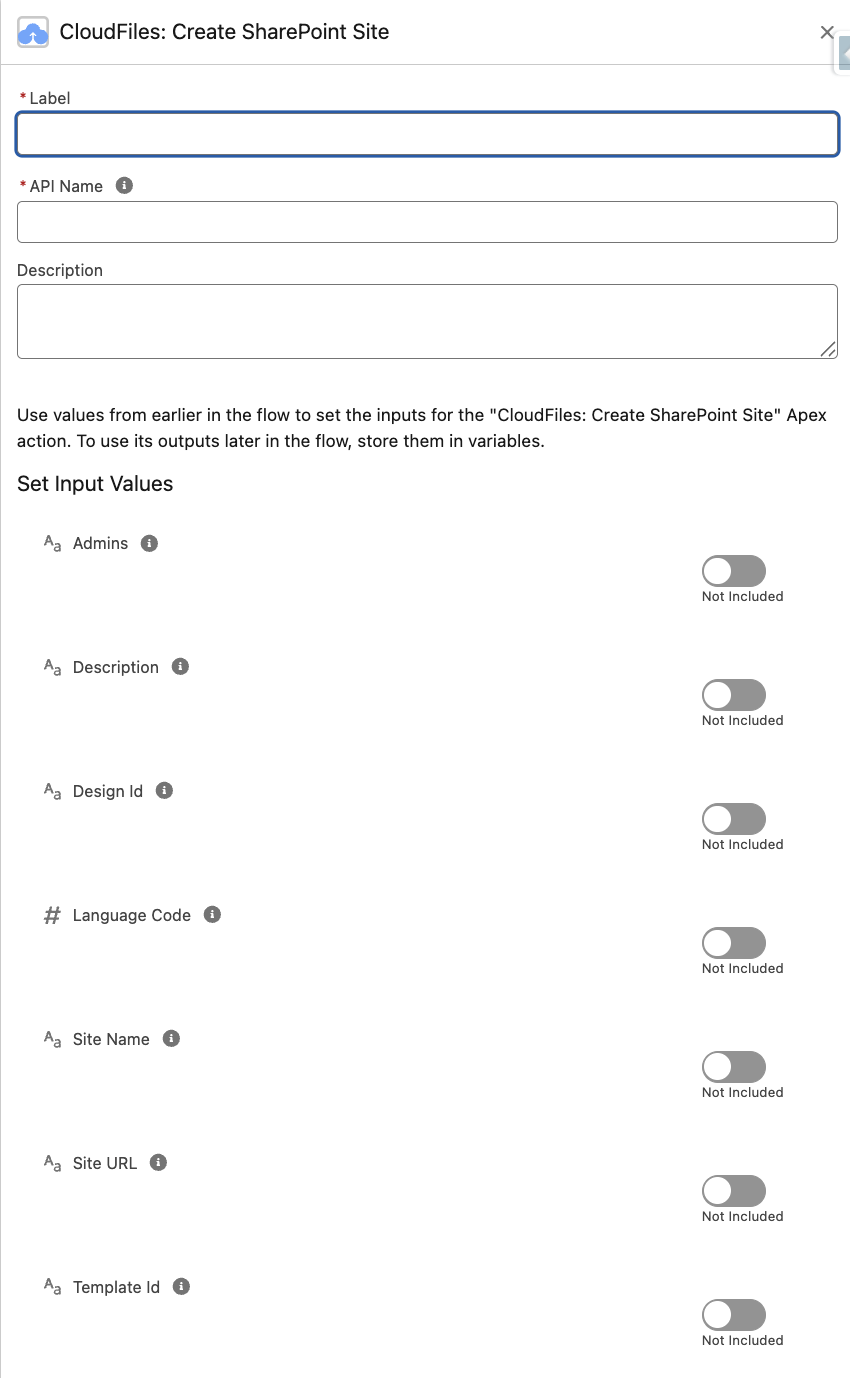
The image below provides an overview of the input parameters and how this action appears in a Salesforce flow. Detailed descriptions of the input and output parameters are provided in the following sections.
What this action does
The Create SharePoint Site action simplifies the process of provisioning SharePoint sites through automation.
Scenario:
For instance, when a new account is created in Salesforce, a corresponding SharePoint site can be automatically generated using this action. The site can be tailored to the specific needs of the account, such as hosting documents, managing tasks, or collaborating with the client’s team.
This automation eliminates the need for manual setup and ensures consistency across your SharePoint environment.
Important: Microsoft 365 tenants can contain up to 2 million SharePoint sites across the organization. CloudFiles automated site creation flows will count toward this limit. If your tenant is near this limit, site creation may fail.
Input Parameters
The following input parameters are required to configure the Create SharePoint Site action:
Admins
Description: A list of email addresses that will be granted admin-level access on the created site at the time of site creation.
Use case: Provision SharePoint access at scale from a Salesforce flow — create a site group per account, bulk-add contacts as members, and apply custom SharePoint roles without being limited to the three default roles.
Notes: Each email must correspond to a valid user in your Microsoft 365 organization.
Multiple emails can be provided, and all listed users will be provisioned as Site Collection Admins upon site creation.
Description
Description: A brief summary explaining the site's purpose or content.
Where it shall be displayed:
Navigate to the SharePoint site.
Go to Settings (gear icon) > Site Information.
The Description field is visible here.
Design ID
Description: A unique identifier for the site's design, referring to a site design or customization for layout, branding, or functionality.
How to Get It:
Available in the SharePoint Admin Center:
Open Microsoft 365 Admin Center > SharePoint Admin Center.
Select the site from the Active Sites list.
Custom site designs are often applied using PowerShell or site scripts.
Language Code
Description: Specifies the language of the site using an ISO language code (e.g., 1033 for English, 1036 for French). If not, Input Default Language shall be Organisation's Default Language.
Where to find current Language:
Go to Settings > Site Settings > Language Settings in SharePoint.
Check Languages supported by SharePoint for more information.
Site Name
Description: Input the display name of the site, reflecting its purpose (e.g., Marketing Team).
Site Name is a mandatory Input Parameter
Site URL
Description: Configure and input the web address for accessing the site, typically in the format: https://<organization>.sharepoint.com/sites/<site-name>
Site URL is a mandatory input parameter.
Template ID
Description: Identifies the template used to create the site, determining its structure and features (e.g., STS#0 for a Team Site).
How to Get It:
Use PowerShell with the command: Get-SPOSite -Identity
Alternatively, check the SharePoint Admin Center for certain configurations.
Here are some common SharePoint site's template Ids:
- STS#0: Classic Team Site
- APPCATALOG#0: App Catalog Site
- BDR#0: Document Center
- BICenterSite#0: Business Intelligence Center
- SITEPAGEPUBLISHING#0: Publish dynamic content to keep people informed
- GROUP#0: For reporting only
- POINTPUBLISHINGPERSONAL#0: For reporting only
- SPSPERS#10: For reporting only
- PWA#0: Project Web App Site
- PWS#0: Microsoft Project Site
- SGS#0: Group Work Site
- SPS#0: SharePoint Portal Server Site site template
Output Parameters
Primary Drive ID
The unique identifier for the SharePoint site's primary document library.
Site ID
A unique identifier for the created SharePoint site.
Site Name
The display name of the created site.
Site URL
The web address for accessing the newly created site.