Introduction
In this test drive, you'll see how CloudFiles Document Management & Sharing integrates with Document AI to intelligently process external files uploaded via the CloudFiles widget into SharePoint — and automatically update their corresponding SharePoint Columns.
The system detects uploads (e.g., Driving Licenses or Passports), classifies the document type using AI, extracts key details like holder name, ID number, and expiry date, and populates the associated SharePoint metadata columns — all within seconds.
In order to access this test drive, head over to our Salesforce AppExchange listing & click on the 'Try It' button. Enter your information to open the test drive org. Once the test-drive is open, navigate to this article within the Instructions tab of the Test Drive.
Instructions
The test drive runs in a Salesforce org that already has CloudFiles installed, so there is nothing to set up before you start.
To experience this automation in action:
- Go to the 'KYC Uploads' tab and create a new record. No additional input is required — just save the record.
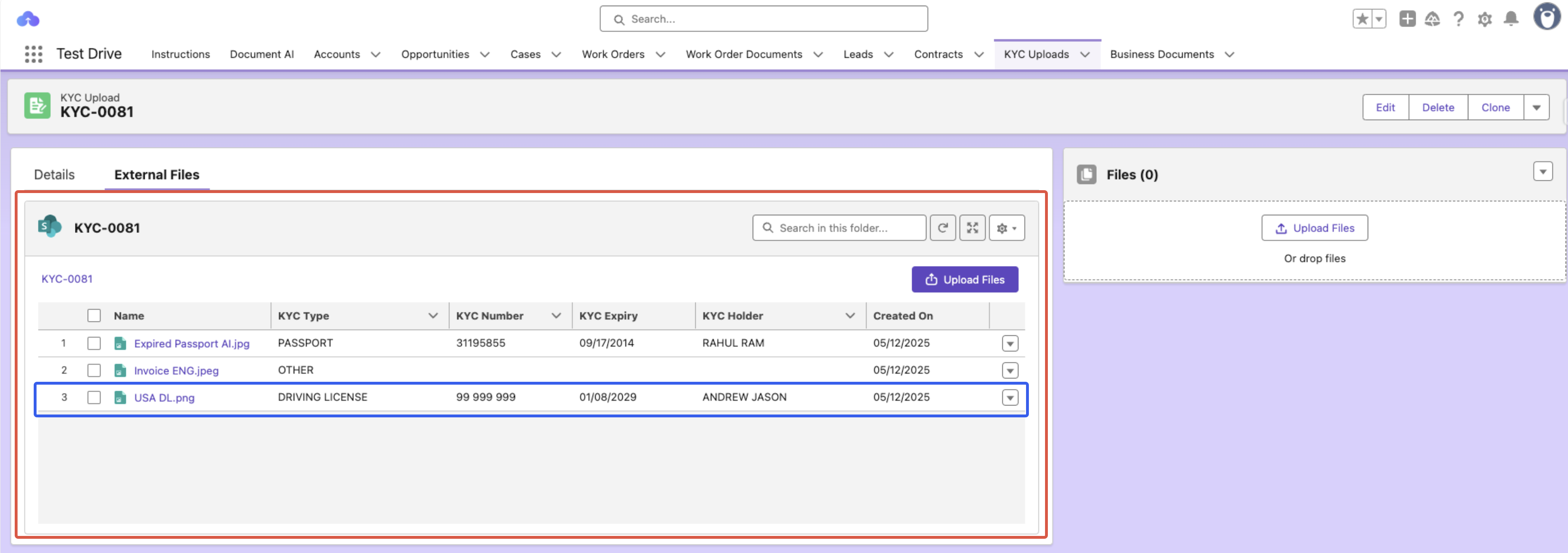
- Go to the ‘External Files’ tab on the record and Upload KYC Documents (Driving License or Passport) via the CloudFiles widget. This will upload the file directly into the connected SharePoint folder.
- Observe AI-Powered Updates
- Once uploaded, the documents will be processed using CloudFiles Document AI.
- The AI system will classify the file type and update KYC Type column
- Extract fields like Holder’s Name, Document Number and Expiry Date and Auto-update SharePoint columns: KYC Type, KYC Number, KYC Holder, KYC Expiry
Refer to the image below for visual understanding of the above steps -
Implementation
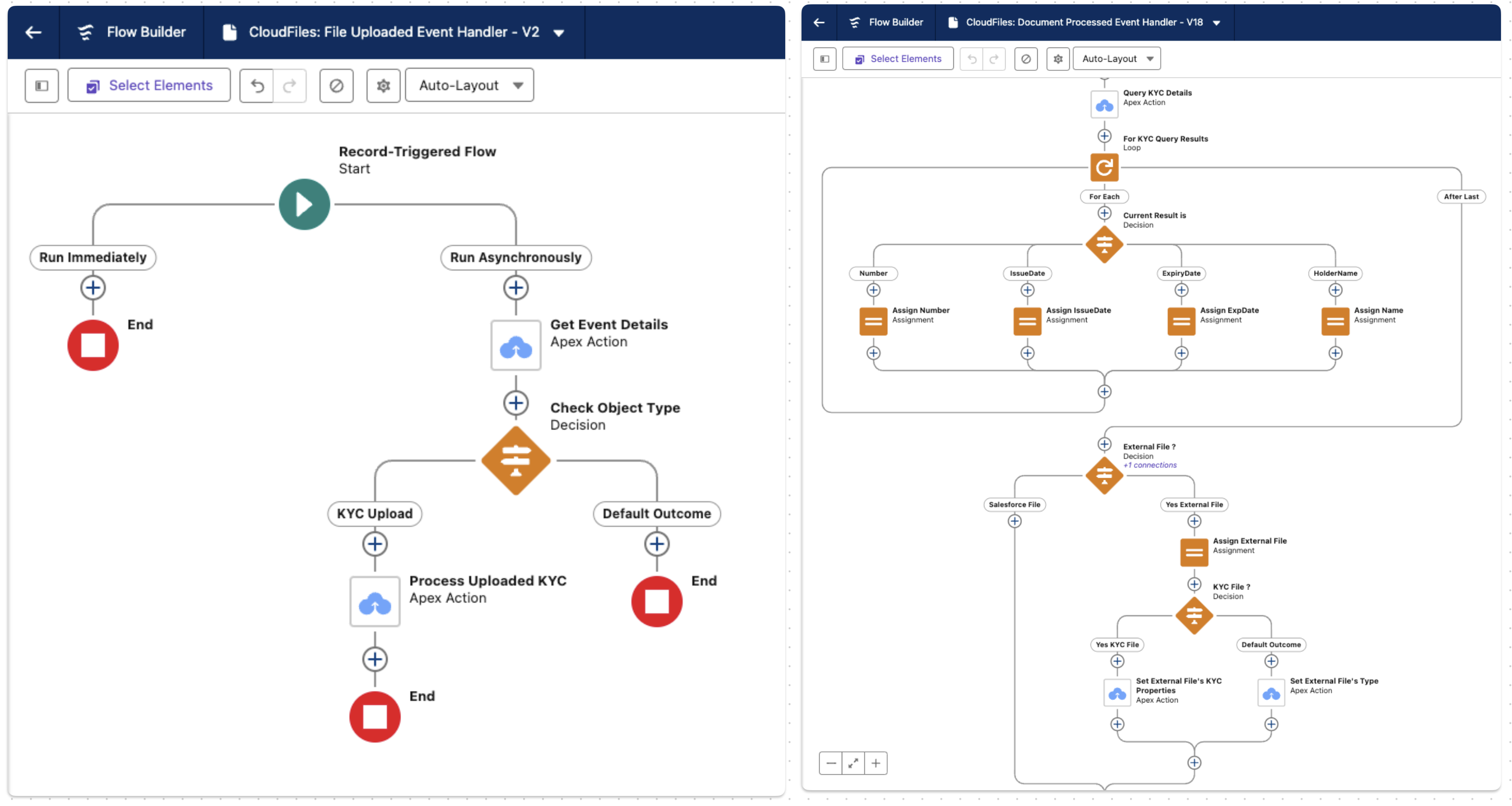
This demo is powered by Salesforce Flows + Events + Flow Actions. Here's how it works behind the scenes:
- File Upload into SharePoint via the CloudFiles widget triggers a File Uploaded event.
- This event initiates the Process Document using AI flow action.
- Once processing is complete, a Document Processed event is published.
- The flow then uses Query Document/Dataset to extract specific data from the file.
- Finally, using Set Resource Property, the extracted values are written into the corresponding SharePoint columns.
CloudFiles handles both the AI-based document's data extraction and the document management layer, including file uploads to external storage and metadata updates.
The below image shows snippets of the flows implemented for this test drive:
For more information, please refer to Document AI Tutorials.
Beyond this Test Drive
This test drive highlights how CloudFiles AI can automatically update SharePoint columns with structured metadata extracted from uploaded files. But the true potential comes when these column updates are treated as live business data that drive visibility, compliance, and automation — directly from SharePoint.
Here are some practical applications across industries:
Banking & Financial Services – KYC & Compliance
Columns like KYC Type, Document Number, and Expiry Date are auto-updated. Compliance teams simply filter the “Expiry Date” column to track expiring IDs and schedule reminders.
Example: A wealth management firm runs a weekly SharePoint view showing all client IDs expiring in the next 30 days — reducing regulatory breaches.
Healthcare – Patient & Insurance Processing
Insurance card uploads populate columns such as Policy Number and Coverage Expiry. Staff sort by “Coverage Expiry” to ensure policies remain valid before patient billing.
Example: A hospital avoids claim denials by flagging expired policies directly from SharePoint without manually opening files.
Education – Enrollment Document Validation
Uploaded student forms auto-fill DOB, Student Name, and Enrollment Number. Admissions staff use columns to quickly check completeness.
Example: A university sorts by “Enrollment Number” to identify which student applications are missing required proof of ID.
Human Resources – Employee Certifications
Training or certification documents auto-update Certification Expiry and Employee ID columns. HR uses these fields for proactive compliance.
Example: A company monitors “Certification Expiry” to trigger retraining notifications 90 days before licenses lapse.
Legal & Contract Management – Renewal Tracking
Contracts update columns like Client Name, Signed Date, and Renewal Date. Legal teams rely on these columns for renewal pipelines.
Example: A law firm builds a SharePoint view filtered by “Renewal Date” to ensure contracts are renegotiated before expiration.
Procurement & Retail – Vendor Document Verification
Invoices and POs populate Vendor Name, PO Reference, and Invoice Amount. Teams can validate consistency directly from columns.
Example: A retailer cross-checks “Invoice Amount” against approved PO values to instantly flag mismatches.
Column Updates as Triggers
Beyond visibility, column updates themselves can act as triggers for downstream AI actions:
- Expiry Date → Renewal Flows: Updating the “Expiry Date” column automatically triggers renewal workflows or customer reminders.
- Invoice Amount → Discrepancy Checks: A populated “Invoice Amount” column kicks off a validation flow against Salesforce order records.
- Contract Renewal Date → Task Creation: “Renewal Date” column updates auto-generate follow-up tasks for account managers.
With CloudFiles Document AI + SharePoint integration, every uploaded file becomes more than static storage. It becomes structured, actionable data — driving compliance, automation, and intelligent workflows across Salesforce and SharePoint.